Onboarding an AI agent platform as a chat with its own assistant
Why I turned down a guided tour for Alloy, what the conversation asks, and what I learned when the restyle got taken apart
· 4 min read · Nikita Miezhenski
Alloy is a platform where a company runs AI agents next to its people, with shared knowledge, workflows and integrations, and every workspace has an assistant called Ally. I worked with Alloy as a contractor in 2026. My task was the first minutes in a new workspace.
The brief
A new workspace had no onboarding. A new user landed on a sidebar of thirteen sections, from Omni Hub and Staff to Variables, MCPs, Flows and Logs, and had to work out alone where an agent comes from. Alloy had no data on where people gave up, but the product has a lot of features and the interface didn’t help.
The CPO had a guided tour in mind: a cursor that moves and clicks on its own to show where things are, then asks the user to click. I went another way. Alloy is an AI product through and through, an operating system for AI agents, so the onboarding should be AI too: a conversation with Ally, the assistant every workspace already has.
The hypothesis
If Ally runs the setup as a chat, a new user gets to a first working agent sooner than through settings pages, and Ally learns about the business on the way. Before drawing anything, I signed up to Alloy and went through the onboarding of other products. Notion’s worked best: its AI offers to set up the workspace in a chat, and I took apart why that works.
What the conversation asks
The onboarding runs inside the normal Alloy interface, so the sidebar is there from the first minute. Ally opens with one question, what to build first, and two answers: an agent for the company’s website, or agents for internal operations.
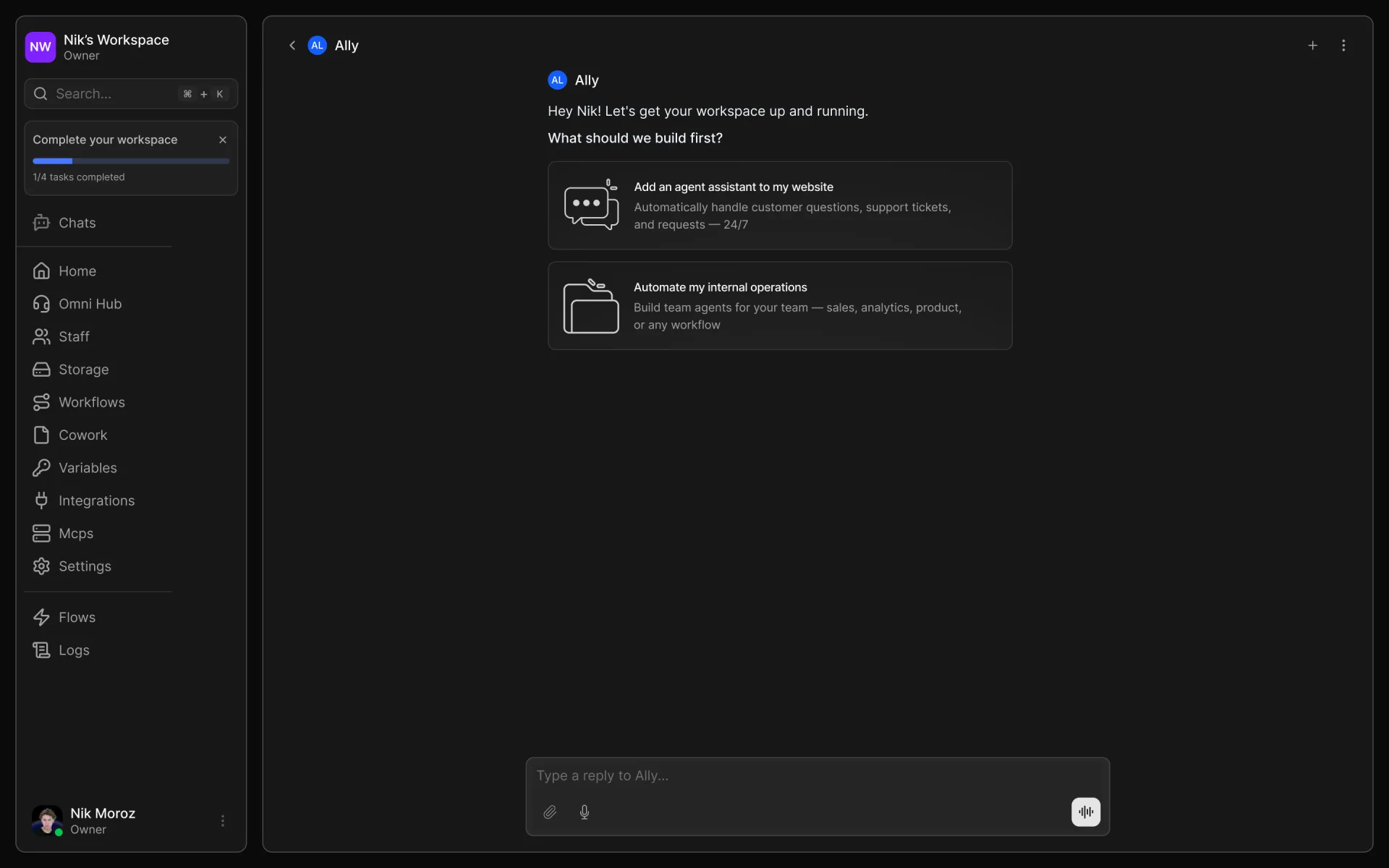
Two short questions follow, what the company does and the user’s role, each with ready answers as chips. Every reply from Ally carries a collapsed “Thought for 15 seconds” line, as in Alloy’s own chat. Then Ally asks about the business and says it will use the answer to train the assistant. The user can drop files, paste the website address, type a few lines, or skip with “I’ll share it later”.
Next Ally asks which routine the agent should take on, with three presets (lead qualification, FAQ and support, product navigation and upsell) or a task in the user’s own words, and asks for a name. The last message says the agent is live and gives a script to paste on the website, with a link to the webchat settings for colors, avatar and trigger rules.
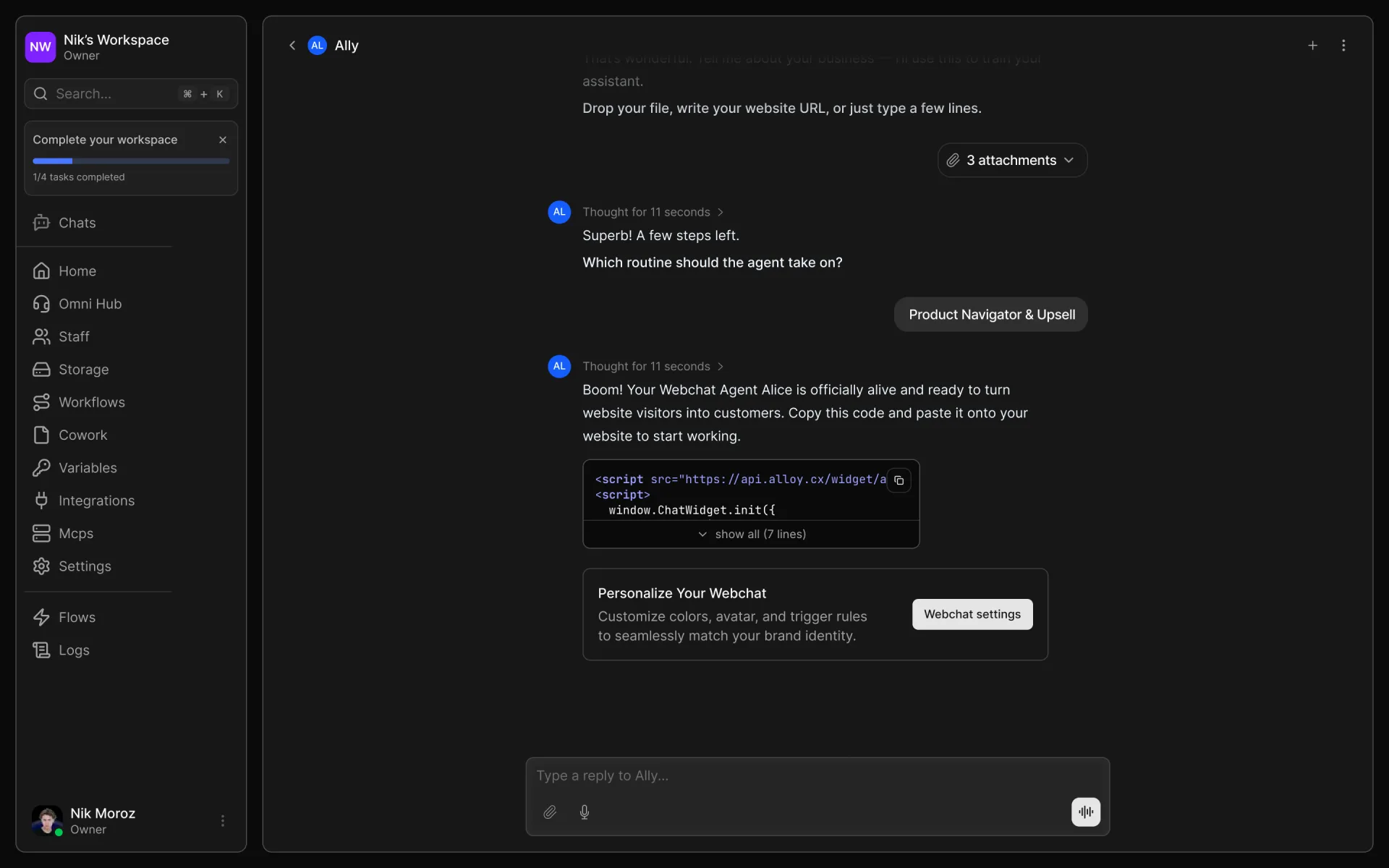
Skipping the files doesn’t block the launch. The agent still goes live, but Ally warns that its memory is empty and points to Storage, where the files can be added later. A “Complete your workspace” card in the sidebar keeps the rest of the setup in view as a short checklist with progress: create the first agent, feed the system with company data, connect an external source, invite the team.
The first screen asks one question and ends with a working agent.
What held up, and what didn’t
The CEO and the CPO liked the onboarding, and the deck went down well. The restyle of the Staff page and Ally’s panel, built on HeroUI and shadcn, got taken apart on UX. They asked why I left so much empty space, since their rule is to use every bit of the screen, and I had no argument ready. The onboarding held up because I could show how Notion does it and why it works. The restyle didn’t, because it rested on my taste.
Soon after, Alloy shifted its effort from improving the product to rolling it out to customers, and the work ended there. As far as I know, none of it reached the product, so there are no numbers.
What I took from it: don’t copy another product’s pattern without knowing why it works there. Find out who will look at the work before choosing how it looks; my first deck was red, and they said it looked as if someone had been killed, and AI companies sell transparency and trust, so it became white and blue. Stakeholders read UX and business logic before beauty. And back every decision. Now every project starts with analytics and user interviews, so the argument comes from users, not from me.