Ask the database in plain language, then show your work
Basetalk: how a text-to-SQL assistant earns a manager’s trust, and where it should hand over to a person
· 3 min read · Nikita Miezhenski
In a company, most questions about metrics go through a few analysts. It takes too long to get from a question to an insight, experts burn out on small requests, knowledge stays in silos, and pasting company data into a third-party AI risks a leak. Basetalk lets a manager ask about company data in plain language and get a chart or a table back, without waiting for an analyst. Our team, Tsentrifuga, built it at the final of a Russian national hackathon in April 2026, on a case from Drivee, and took second place overall among more than 300 finalists. After the hackathon it was adapted and now runs at Zunami, a large regional IT company that works with insurers, on local models, so the data stays in-house.
The design problem was trust
A chat makes an answer easy to ask for. It still has to help a person decide whether the answer is right. A manager who gets a wrong number with a confident sentence around it is worse off than one who waited for the analyst. There was little time for research, so I looked at how OpenAI, Grok and Gemini design their assistants and borrowed their patterns where they fit.
What the screens do
A manager writes a question the way they would ask a colleague, for example “Show revenue by cohort for January”. The start screen offers topics to begin with and a picker for the data source. The assistant turns the question into SQL, runs it against the database and returns a chart or a table.
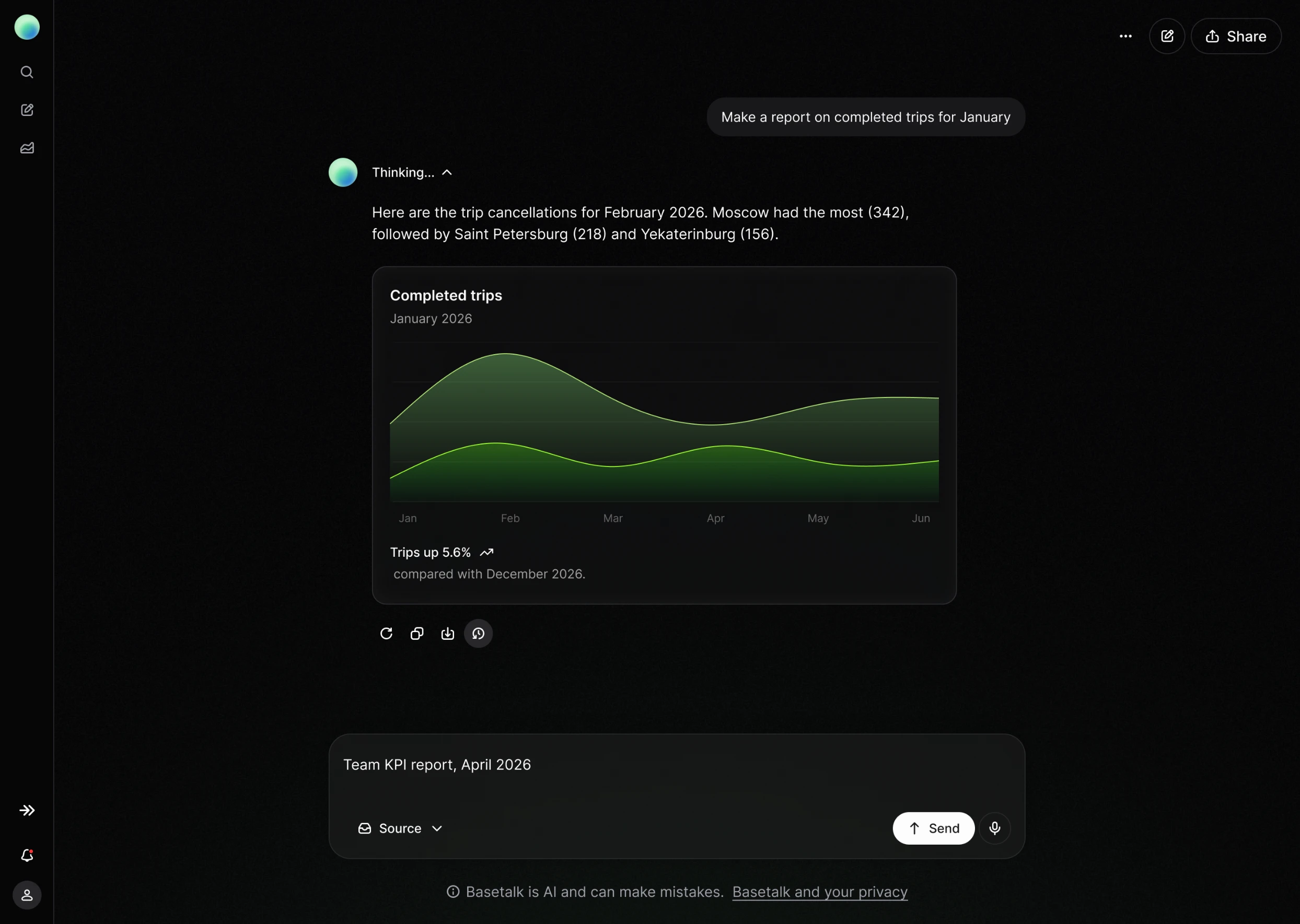
When a request is ambiguous, the assistant asks first (“Do you mean the report on product teams?”). While it works, it spells out what it understood: the metric, the filters, the grouping and the sort order. The answer comes with a short explanation, a chart card and a button to turn it into a report. A person can see the interpretation and catch a wrong one before trusting the number.
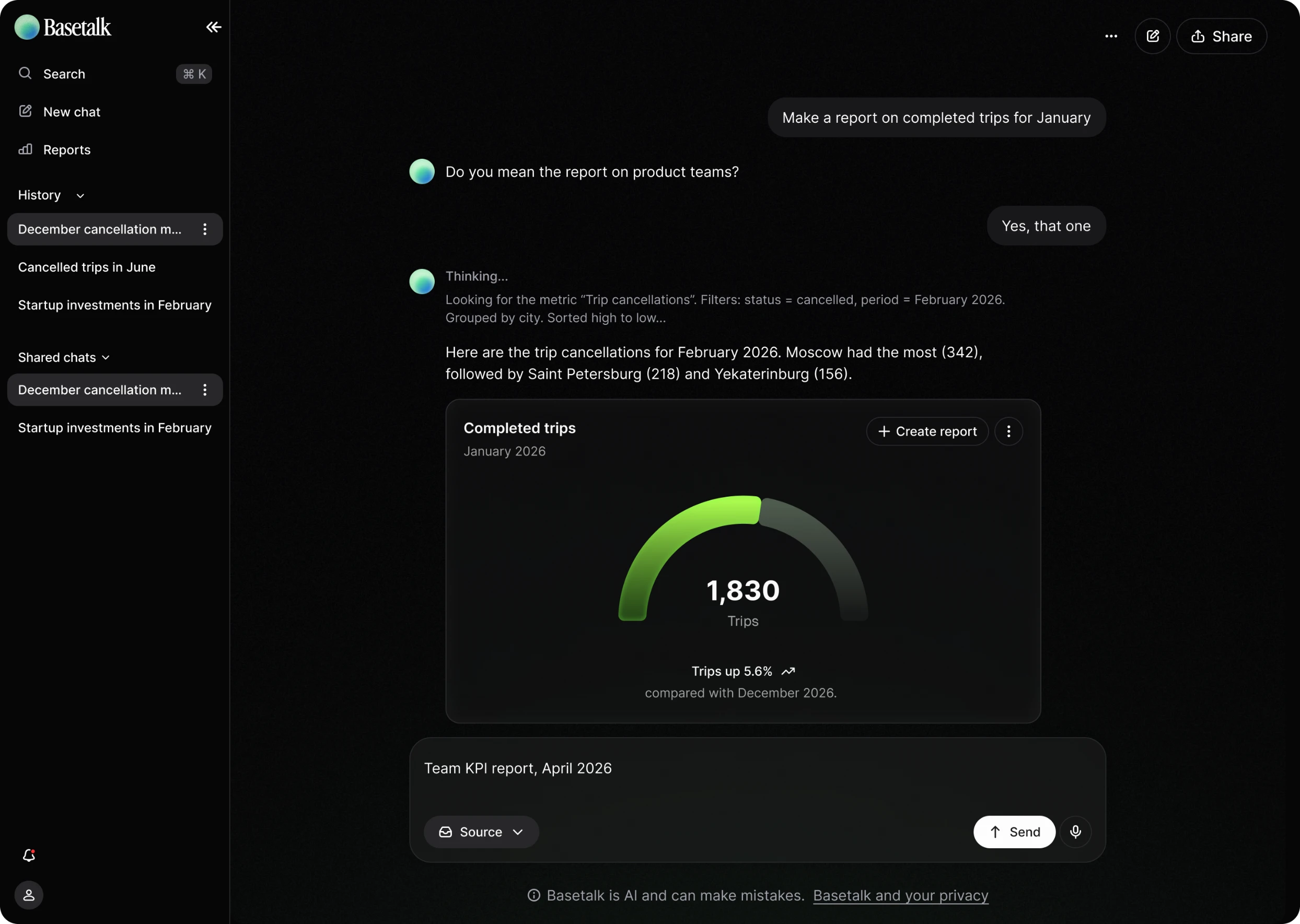
A clear answer is not the same as a justified one.
I also designed a Tasks screen for questions a team asks on a schedule. A person saves the request once and picks how often it runs, along with the database and the time. Each run keeps its answer and chart, and a task can be run on demand.
Under the hood, and the open question
Basetalk connects to the company’s databases (SQL, Postgres, ClickHouse and others), Git, Jira and Confluence, and answers from them in one conversation. The model was Gemma, running locally, with retrieval over the database schema and safeguards against destructive queries. All of this worked in the prototype; the numbers on the screens are demo data.
The open design question was where the assistant should stop. When it is not sure, the question should go to a human analyst instead of a confident guess. Handing a question to a person deserves as much design as delivering a good answer, and that hand-over is what I would build next.
My part: product and interface design, brand, pitch deck, handoff to developers, and a promo video in After Effects. The prize was about $1,240, converted from roubles at the Central Bank of Russia rate on 28 October 2026.